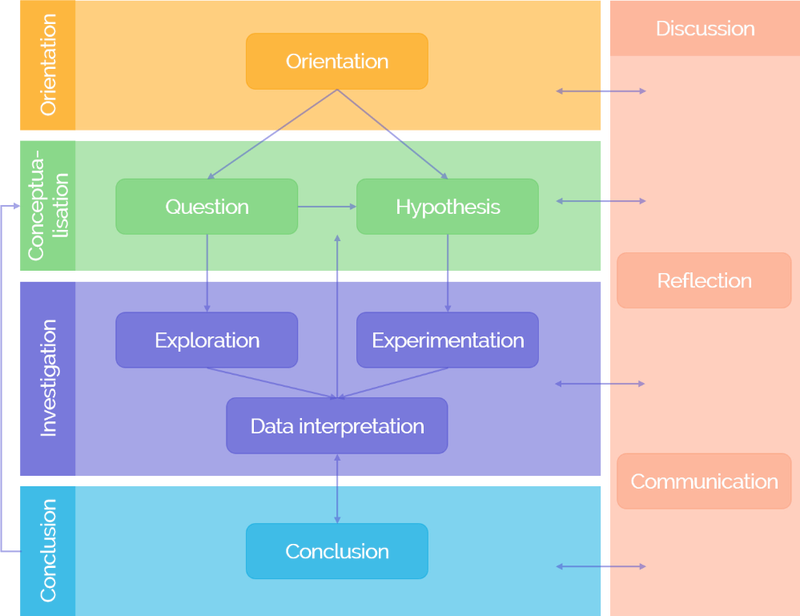
Inquiry-based learning (IBL) is an educational approach that emphasizes the importance of student-driven questioning and exploration to enhance understanding and retention of knowledge. This method is rooted in the belief that personal experience and active engagement lead to deeper learning than traditional rote memorization. IBL encourages students to start with prior knowledge, form hypotheses about unknown concepts, and conduct investigations to find answers, often with the guidance of a facilitator, typically a teacher.
The approach is designed to foster curiosity, motivation, and critical thinking skills, allowing students to apply their learning across various subjects. For instance, a student might explore the melting rates of ice under different conditions, linking scientific inquiry to real-world phenomena. While IBL has been championed for its ability to develop independent learning skills, it faces challenges in implementation, such as time constraints, resource availability, and alignment with standardized testing. Educators also note that the success of IBL can depend on both the students&
039
; foundational knowledge and the facilitator&
039
;s skills. Despite these challenges, IBL remains a widely discussed and evolving pedagogical strategy in modern education.